Showing posts with label Sydney. Show all posts

Thursday, 6 March 2014

Annual Meeting of the Aborigines at Parramatta


Earle, Augustus, 1793-1838.
The annual meeting of the Aboriginal tribes at Parramatta, New South Wales, the Governor meeting them [picture]
[1826?] 1 watercolour ; 17.1 x 26 cm. (National Library of Australia)

On the 28 December 1814 Governor Macquarie organised a meeting with local tribes at Parramatta to discuss the enrollment of children in a newly formed "Asylum for Native Children". At one o'clock Macquarie and his wife, accompanied by a number of civil and military officers, arrived at the market place adjacent to St John's Cathedral. After talking for an hour to overcome the suspicions of the local aborigines three children were finally yielded up to the project and a meal of roast beef and ale was provided to those in attendance.   

Friday, 28 February 2014

Wine, Tabacco, and Maize, 1791, Schaeffer's Farm, Parramatta

A later view of the original site of Schaeffer's farm showing 'Subiaco'

December 7, 1791, ... Went to Schaeffer’s farm. [see history of this site] I found him at home, conversed with him, and walked with him over all his cultivated ground. He had one hundred and forty acres granted to him, fourteen of which are in cultivation, twelve in maize, one in wheat, and one in vines and tobacco. He has besides twenty-three acres, on which the trees are cut down, but not burnt off the land. He resigned his appointment, and began his farm last May; and had at first five convicts to assist him: he has now four. All his maize, except 3 acres, is mean.

Tuesday, 3 December 2013

World War One Trophy Guns for Parramatta


105mm L22 Howitzer, presumed to be similar to the Parramatta Trophy Gun, http://www.overvalwagen.com/HIHSiderius2.html

At the end of World War One a number of weapons captured form German, Austria/Hungary, and Turkish forces were rounded up to serve as gifts to townships across Australia. While committees were set up to oversee the distribution to townships and cities some of these were selected to form what is now the Australian War Memorial collection, and others were given to Army units linked the guns capture. It was also suggested that some of the smaller weapons be allocated to schools, although it appears the then Minister of Education stepped in to stop this happening.[i] Even so guns did find their way to Scouts groups and to some private schools, like King’s College.

Tuesday, 29 October 2013

Roxy Theatre - Australian Cinema Entertainment Program 1930s

Held in the cultural collection at the Parramatta Heritage Centre is an entertainment program from the Roxy Spanish Theatre.  This booklet lists a program of entertainment including a range of 1930s movies such as This is the Night with Cary Grant and No More Orchids with Carol Lombard.  There are many other films listed on the packed program as well as boxing matches, wrestling, vaudeville and an organ recital.


The Roxy Theatre opened on 6th February 1930 with a packed audience coming to watch Maurice Chevalier’s, Innocents of Paris.  An interested crowd of several thousand observed the proceedings in the street opposite.  The Roxy is one of the few remaining examples of the “Picture Palaces” that were built between the wars. 

Wednesday, 23 October 2013

Faust - an individual sense of style.

Ceiling Mural by Joseph August Faust, Collection of Parramatta Heritage Centre

There is much we don’t know about Joseph August Faust.  What we do know is that he was born in New York in 1871, of German heritage and spent his childhood in Pittsburgh.  He migrated to Sydney in 1887 and was working as a painter and decorator in 1890.  His first marriage to Mary Sparrow was in 1895 and they had a son Joseph Paul.  Mary died in 1925 and he subsequently married Beatrice Inch in 1929, followed by Ita Reeves in 1937.  He died in 1939 aged 67. 

Saturday, 12 October 2013

The Man They Couldn't Hang: Joseph Samuel.


Joseph Samuel lived a very eventful but short life. He arrived in Sydney in 1801 on the Minorca/Canada after being sentenced to seven years in England for larceny at the age of fourteen in 1795. 

His life in Sydney was one of petty crime and unfortunate associations.  The events leading up to his attempted hanging included a large cast of characters and involved a complex series of events that included a robbery and a grisly murder. 

Friday, 4 October 2013

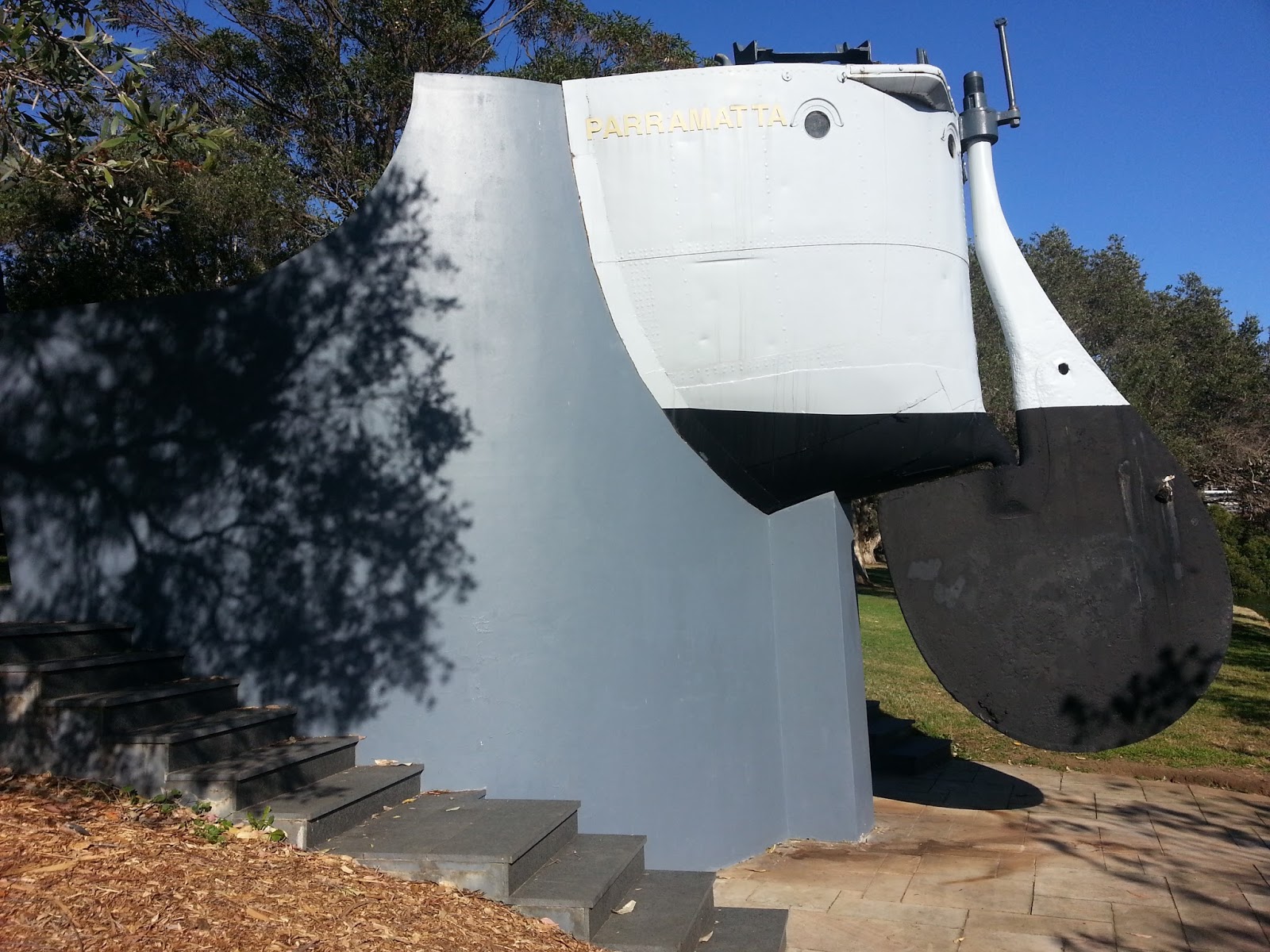
The HMAS Parramatta Memorials, One and Two.


The stern of HMAS Parramatta I which forms the Memorial
at Queens Wharf, Parramatta. Photo Peter Arfanis

With the upcoming HMAS Parramatta IV Freedom of the City Parade fast approaching it is worth paying a visit to the two HMAS Parramatta Memorials at the Queens Wharf, Parramatta.

The two HMAS Parramatta Memorials commemorate the service of all the ships to bear the name Parramatta in the Royal Australian Navy. The first of the ships was the torpedo boat destroyer which served with distinction in the Pacific and Indian Oceans and the Mediterranean in World War I. The second ship, a sloop, served in the Far East, Red Sea and the Mediterranean. She was sunk by the German submarine U559 off Tobruk on 27th November, 1941. One hundred and thirty seven of her crew were lost in the action. Only twenty four crew survived. The third Parramatta, a destroyer escort, was commissioned in 1959 and  decommissioned in 1991. The fourth Parramatta was launched in the year 2000 and is still in service.

Wednesday, 25 September 2013

Boxing Match, Baulkham Hills, Jack Kable v George Glew, 1827

A typical 19th-century boxing match, often held in warehouses, courtyards of inns, or in open fields away from the eyes of local authorities. This painting was by boxer Jim Byrne's friend Jem Ward, http://en.wikipedia.org/wiki/File:Ward_painting.jpg
The following blow-by-blow description of a boxing match at Baulkham Hills, near Parramatta, was taken from 'The Australian' and gives us an insight into the popularity of boxing in Colonial Sydney and the colourful language of the times. Jack Kable came to the attention of the press after beating Bill Clark in five rounds in a boxing match on Parramatta Road on 20 February 1824 and later he beat Joe Dargin at the Windsor Racecourse in 11 rounds.

"TURN-UP FOR ONE HUNDRED POUNDS A SIDE —BETWEEN KABLE AND GLEW .        
"Black spirits and white, Red spirits and grey, Mingle, mingle, mingle, Mingle while you may."  
News of this long since anticipated ,"turn-up" being chalked down as a "dead certainty" for Monday morning last, spread like wild fire in a drouthy summer, and set the Sydney "kiddies" on their pivots all Saturday and Sunday. Every "gymnastified" amateur, each gentle and simple flat and knowing "un" that could muster a "prad," a "shay," or a "heavy drag," might be seen and heard, " like claps of thunder," rattling their "tits" along the streets and off along the Parramatta-road from peep o'day on Sunday, and for 3 or 4, and more than 20 hours after: and many a " cove " that would not, or could, not raise the wind, toddled it on " shanks mare," with, or without a "pal" to while away the journey.

Wednesday, 21 August 2013

The 'Red Cow' Inn Parramatta

Red Cow Inn, Parramatta
In colonial times most visitors to Parramatta would have had to choose between stopping over at one of its two most famous inns, The ‘Red Cow’ or the ‘Woolpack’. The first of these stood at the rear of the site of the present Commercial Bank in George street. While the name ‘Red Cow’ seems a little prosaic it was actually a very literal reference to the many red cows grazing in the pastures around the newly formed town. The earliest reference I could find to the inn was an 1803 advertisement posted by John Williams, a draper, who advertised his shop as being ‘... opposite the RED COW.’ One of its earliest functions was a supper held within its walls in October, 1814, to celebrate the victories of Wellington over the Napoleonic forces in Spain. 

Monday, 5 August 2013

St John's Cathedral, Parramatta

St John's Cathedral, 1913, from publication Centenary Celebration's, Anglican Church, Australia, Heritage Centre Collections, Parramatta Council 
This site located just a few minutes from the Parramatta train station is the oldest church site in Australia in continuous use and is a significant component of the evidence of the early township of Parramatta.