Saturday, 12 October 2013

The Man They Couldn't Hang: Joseph Samuel.


Joseph Samuel lived a very eventful but short life. He arrived in Sydney in 1801 on the Minorca/Canada after being sentenced to seven years in England for larceny at the age of fourteen in 1795. 

His life in Sydney was one of petty crime and unfortunate associations.  The events leading up to his attempted hanging included a large cast of characters and involved a complex series of events that included a robbery and a grisly murder. 

Saturday, 5 October 2013

The Ship's Bell, HMAS Parramatta III

Ship's Bell from HMAS Parramatta III. Parramatta Heritage Centre
The ship's bell has a centuries long tradition of use in navy and merchant ships. Bells are used for timekeeping, sounding alarms, and ceremonies, including baptisms. It is Navy tradition for a ship’s bell to be used only for the one dedicated ship. Each new ship commissioned has a new bell.  

A ship’s bell is usually made of brass or bronze and inscribed with the commissioning date of the ship to which it belongs. It is unique to the ship and commemorates the service of that ship. In the possession of Parramatta City Council is the ship's bell from HMAS Parramatta III which was commissioned on 4 July 1961 and decommissioned on 11 January 1991. Parramatta III was the first of the Type 12 frigates built in Australia and saw active service during the Vietnam War as an escort for the fast troop transport HMAS Sydney and also patrol duties during the Indonesian Confrontation between 1964 and 1965.

Friday, 4 October 2013

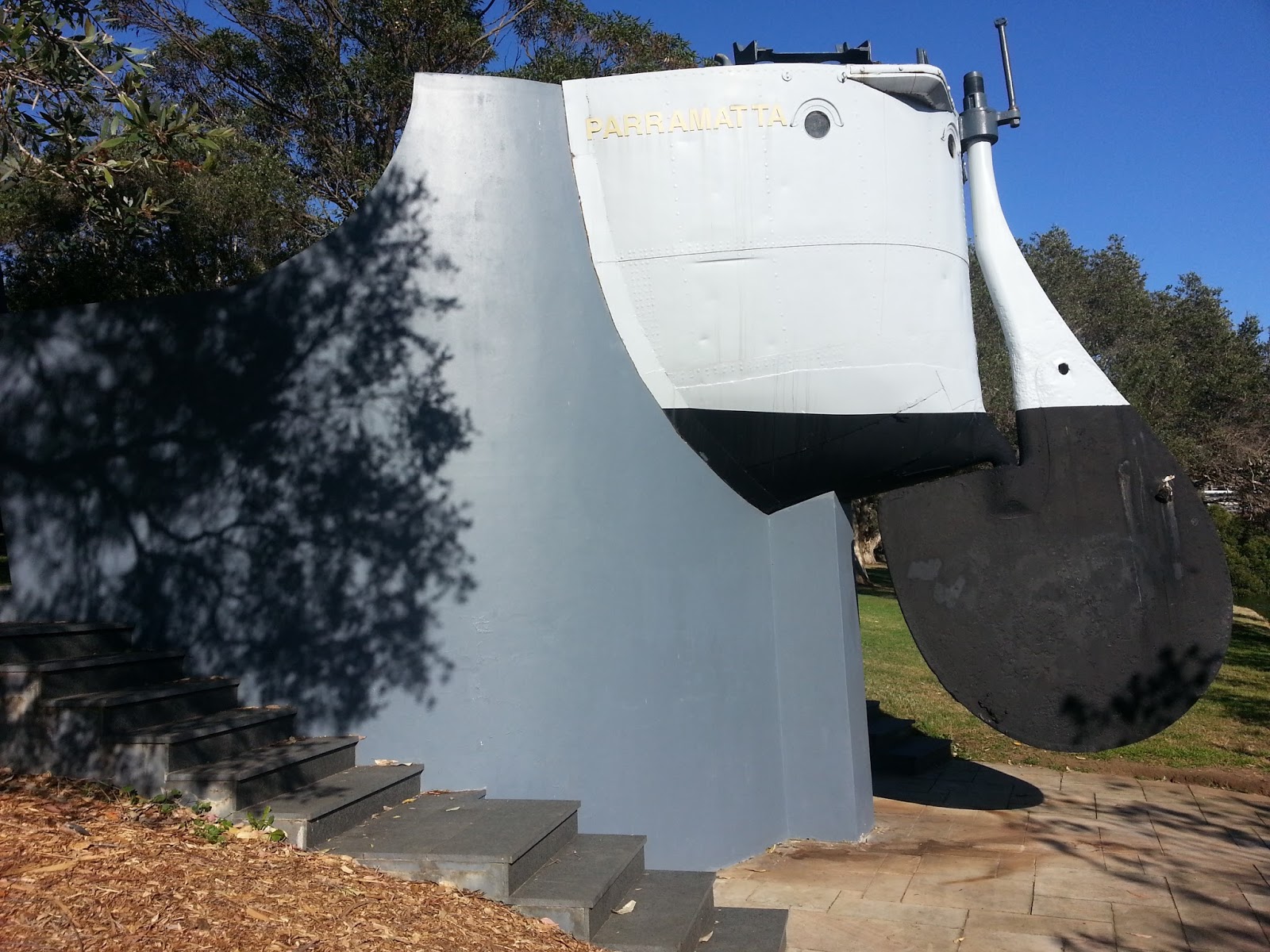
The HMAS Parramatta Memorials, One and Two.


The stern of HMAS Parramatta I which forms the Memorial
at Queens Wharf, Parramatta. Photo Peter Arfanis

With the upcoming HMAS Parramatta IV Freedom of the City Parade fast approaching it is worth paying a visit to the two HMAS Parramatta Memorials at the Queens Wharf, Parramatta.

The two HMAS Parramatta Memorials commemorate the service of all the ships to bear the name Parramatta in the Royal Australian Navy. The first of the ships was the torpedo boat destroyer which served with distinction in the Pacific and Indian Oceans and the Mediterranean in World War I. The second ship, a sloop, served in the Far East, Red Sea and the Mediterranean. She was sunk by the German submarine U559 off Tobruk on 27th November, 1941. One hundred and thirty seven of her crew were lost in the action. Only twenty four crew survived. The third Parramatta, a destroyer escort, was commissioned in 1959 and  decommissioned in 1991. The fourth Parramatta was launched in the year 2000 and is still in service.

Thursday, 3 October 2013

Fast and Furious. The 1938 Parramatta Grand Prix

Leaflet advertising the Parramatta Grand Prix.
Courtesy of Brian Darby's "Aussie Road Racing"
It was perhaps the first time such an event was to be held in Sydney - a Grand Prix in Parramatta Park. The event, conducted under the auspices of the NSW Light Car Club and Empire Speedways was to be held on 5 November, 1938, the finale of a series of events as part of Parramatta’s week long 150th Anniversary celebrations.


Interest from drivers and the public was enormous. Twenty five entries were received and included English driver Peter Whitehead fresh from his Australian Grand Prix win at the newly completed Mount Panorama circuit, Frank Kleinig (holder of the Australian speed record at that time),  Les Burrows and Hope Bartlett. Jack Saywell’s Alfa Romeo capable of speeds of up to 240 kph and John Snow’s Delahaye, two of the fastest cars to have been brought into Australia were also set to oppose each other at the Parramatta Park track, described as being ideal with a good straight and challenging corners.


A grandstand with a capacity for 1100 spectators was built at the start-finish line, one thousand reserve tickets had been sold and about 50,000 people were expected to turn up to watch this historic and adrenalin charged event.


Leading up to the race the safety of the track was reviewed and was tested by several drivers in the presence of police officers on Thursday 3 November 1938. Drivers had been practicing and all was ready for the first Grand Prix to be held in Sydney

Wednesday, 25 September 2013

Boxing Match, Baulkham Hills, Jack Kable v George Glew, 1827

A typical 19th-century boxing match, often held in warehouses, courtyards of inns, or in open fields away from the eyes of local authorities. This painting was by boxer Jim Byrne's friend Jem Wardhttp://en.wikipedia.org/wiki/File:Ward_painting.jpg
The following blow-by-blow description of a boxing match at Baulkham Hills, near Parramatta, was taken from 'The Australian' and gives us an insight into the popularity of boxing in Colonial Sydney and the colourful language of the times. Jack Kable came to the attention of the press after beating Bill Clark in five rounds in a boxing match on Parramatta Road on 20 February 1824 and later he beat Joe Dargin at the Windsor Racecourse in 11 rounds.

"TURN-UP FOR ONE HUNDRED POUNDS A SIDE —BETWEEN KABLE AND GLEW .        
"Black spirits and white, Red spirits and grey, Mingle, mingle, mingle, Mingle while you may."  
News of this long since anticipated ,"turn-up" being chalked down as a "dead certainty" for Monday morning last, spread like wild fire in a drouthy summer, and set the Sydney "kiddies" on their pivots all Saturday and Sunday. Every "gymnastified" amateur, each gentle and simple flat and knowing "un" that could muster a "prad," a "shay," or a "heavy drag," might be seen and heard, " like claps of thunder," rattling their "tits" along the streets and off along the Parramatta-road from peep o'day on Sunday, and for 3 or 4, and more than 20 hours after: and many a " cove " that would not, or could, not raise the wind, toddled it on " shanks mare," with, or without a "pal" to while away the journey.

Friday, 20 September 2013

The Centennial Baths of Parramatta


The Centennial Baths Building on the left of the
Lennox Bridge, currently the site of the Riverside Theatre.
(State Library of Victoria H91.300/394)
By the early 1880s the residents of Parramatta felt it was time they had facilities for bathing. The river was polluted and the youth of the town had little chance to "practice the noble art of swimming." Council felt it couldn't waste any time to have "these necessary adjuncts to cleanliness and health erected".1 A deputation led by Mayor Joseph Booth waited on the Colonial Secretary on 15 June 1883 to request that a Bill be introduced to release a portion of land originally set aside for use as a market. The land in question is the current site of the Riverside Theatre next to the Lennox Bridge.

While there was urgency on the part of Parramatta Council to have the baths erected the process of passing the Bill was slow. In 1886 Mr Hugh Taylor, M.L.A., moved to bring in a Bill that would allow the Council of the Borough of Parramatta to construct and maintain a public baths and to borrow money to do so.  

Wednesday, 11 September 2013

Parramatta's Rangihou Reserve and its Maori History

Rangihou Reserve and vicinity, Parramatta, Google maps, September, 2013 

The Rangihou Reserve in Parramatta was central to Maori activity in Australia in the early 1800s. This was mainly due to the support and encouragement of Samuel Marsden who set up a school and farm to be used by his Maori visitors. The site he chose was in the area surrounding the Rangihou Reserve, originally the territory of the Barramattagal clan of the Darug people.